
Aurora borealis in the Alps
On the night of January 19-20, 2026, the Hautes-Alpes region of France took on a Lapland atmosphere.
In the middle of the night, aurora borealis of exceptional intensity were observed across France, from Brittany to the Alps. Numerous observers witnessed this magical spectacle, illuminating the snow-covered peaks of the Hautes-Alpes.
-
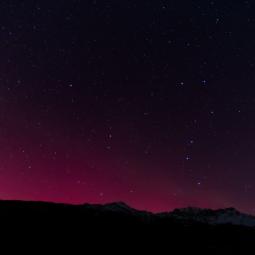 © Jérôme Baron-Campos
 -
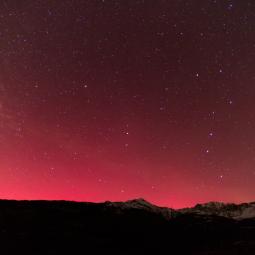 © Jérôme Baron-Campos
 -
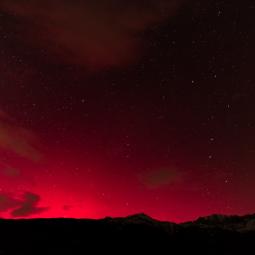 © Jérôme Baron-Campos
 -
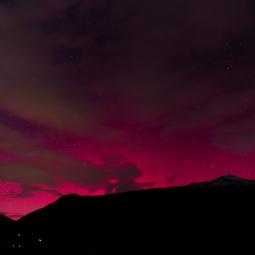 © Jérôme Baron-Campos
 -
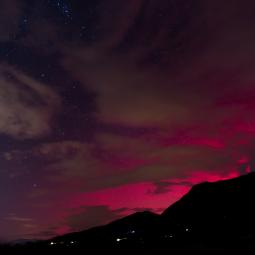 © Jérôme Baron-Campos
 -
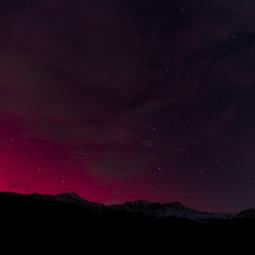 © Jérôme Baron-Campos
 -
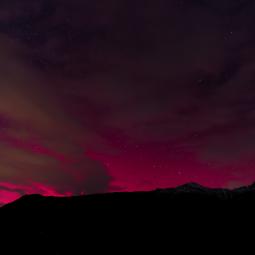 © Jérôme Baron-Campos


What is an aurora borealis?
The aurora borealis are natural lights that appear in the night sky when the Sun's activity is particularly intense. The Sun constantly emits charged particles known as solar wind. During solar storms, these particles reach the Earth in large numbers.
Our planet is protected by a magnetic field that deflects most of these particles. But near the poles, this shield is more permeable. The particles then enter the upper atmosphere (between 100 and 300 km altitude) and collide with the gases present, mainly oxygen and nitrogen.
These collisions release energy in the form of light:
- green is the most common color (oxygen),
- red (oxygen at high altitude)
- violet or blue (nitrogen)
Why are the aurora borealis visible in France?
Usually visible near the Arctic Circle, auroras can sometimes be seen in France when solar activity is very strong. Since 2023, the Sun has been entering a phase of maximum activity, which explains these exceptional appearances at lower latitudes.
In the Hautes-Alpes region, low light pollution, altitude and the quality of the night sky offer ideal conditions for observation, particularly around Lake Serre-Ponçon, far from artificial lights.


Where and how to see the aurora borealis?
Even if the phenomenon is more frequent than in the past, observing an aurora borealis remains exceptional in our latitudes. You need a certain amount of luck, a lot of patience, and the willingness to spend some time outside, at night, in the middle of nature.
Ideal spots and conditions
To maximize your chances, several conditions must be met:
- A perfectly clear, dark sky, with no clouds and, if possible, no full moon
- A total absence of light pollution, far from cities and artificial lighting
- Late-night observation, generally after 10 p.m., sometimes well into the night
- Look northwards, or towards the west/north-west horizon
- A confirmed episode of strong solar activity
To keep abreast of the latest solar news, check out :
Mobile applications with alerts (such as My Aurora Forecast & Alerts), weather forecasts, social networks and groups of astronomy enthusiasts.
Practical advice
Bring warm clothing, even in summer, a hot drink and a headlamp (ideally with a red light to preserve night vision).
Accessible spots around Gap
A number of easily accessible viewpoints offer excellent observation conditions:
- the promontory of the Rambaud bell tower,
- the promontory of the Bâtie-Vieille tower.
What if you're far from the Hautes-Alpes?
Do you live in town and still want to follow the phenomenon?
Check out our webcam aimed at Lac de Serre-Ponçon. It's sometimes possible to catch a glimpse of auroral activity from a distance - a great way to dream... before you come and experience it for real, during a bivouac under the stars in our valleys.
Would you like to discover our valleys?
Find all the inspiration you need to organize your stay in the Serre Ponçon valleys in the Hautes Alpes.


